

Australia Hospitality Market 2026-2034 | Size, Share, Statistics, Outlook
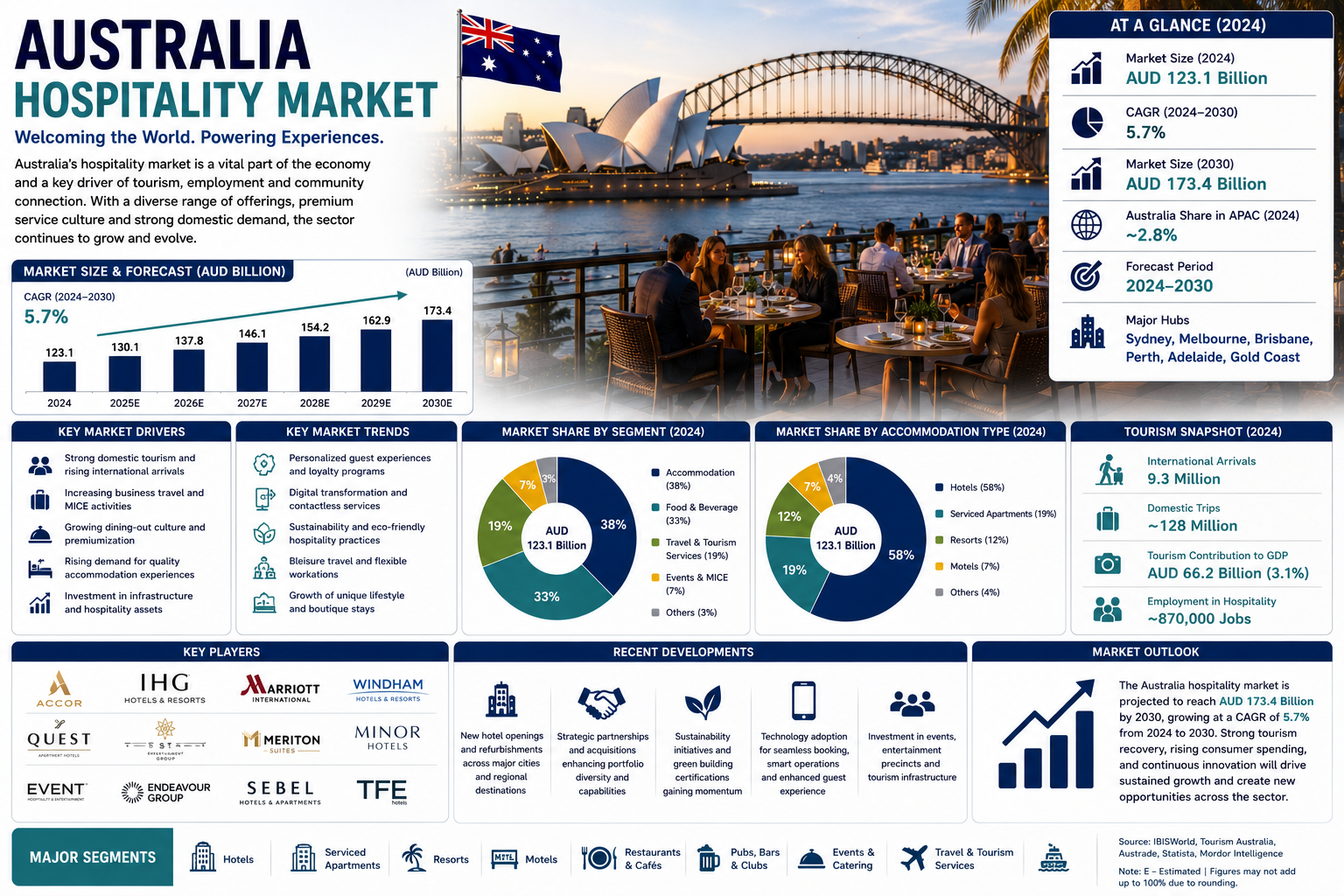
Australia Hospitality Market
Australia hospitality market was valued at USD 37454.48 Million 2025, is projected to reach USD 70933.81 Million 2034, growing at a CAGR of 7.35% 2026-2034.
AUSTRALIA, May 19, 2026 /EINPresswire.com/ --Market Overview
The Australia hospitality market size was valued at USD 37,454.48 Million in 2025 and is projected to reach USD 70,933.81 Million by 2034, growing at a compound annual growth rate of 7.35% from 2026-2034. The market is experiencing strong and sustained growth as tourism recovery, digital innovation, and evolving consumer preferences are reshaping the country's service economy. The hospitality sector, encompassing hotels, resorts, restaurants, event services, and travel-related experiences, is playing a crucial role in Australia's economy. With international visitor arrivals forecast to surpass pre-pandemic levels by 2026-27 and reach a record 10 million international visitors, the demand for accommodation, dining, entertainment, and experiential travel services is accelerating across the country.
Why is Hot Today
The Australia hospitality market is commanding significant attention as the hotel investment sector is rebounding strongly, with transaction volumes climbing to $2.7 billion in 2025, representing an 80% increase from the previous year and 58% above the long-term average. The Federal Budget 2025-26 is allocating a $195.9 million operating budget for Tourism Australia to promote the country as a destination for leisure and business events travel. The Australian Government is also supporting the hospitality sector by pausing indexation on draught beer excise, extending energy bill relief for small businesses, and providing cash flow support through the instant asset write-off. Meanwhile, the tourism investment pipeline is consisting of 363 projects worth $74.5 billion, an increase of $11.1 billion from the previous year.
Market Summary
• The Australia hospitality market is witnessing a significant transformation as customer experience, personalisation, and digital convenience are becoming central to hospitality services, with modern travellers increasingly seeking unique, immersive experiences including wellness retreats, cultural activities, adventure tourism, and personalised services that are prompting hospitality providers to innovate and differentiate their offerings.
• Hotel occupancy rates across Australia are reaching 72.6%, with average daily rates increasing to $250.65, while national occupancy is projected to reach 85-92% during peak seasons, reflecting strong demand recovery across accommodation segments and demonstrating the sector's resilience and growth momentum.
• The food and beverage sector is undergoing a major evolution as hospitality venues are integrating interactive entertainment elements such as bowling, darts, trivia technology, and VR experiences alongside traditional dining, creating multi-experience environments that are driving repeat visitation, longer dwell times, and higher per-capita spending across urban dining precincts.
• Sustainability and eco-friendly tourism are influencing market dynamics as hospitality providers are increasingly adopting energy-efficient practices, waste reduction initiatives, and sustainable sourcing to attract environmentally conscious travellers, with green certifications and carbon-neutral operations becoming competitive differentiators in the accommodation and food service segments.
• The rise of business travel and corporate events is contributing significantly to occupancy rates and revenue generation, with conferences, exhibitions, and corporate gatherings driving demand across hotels and event venues, while the growing popularity of bleisure travel is blending business and leisure trips to extend average stays and boost ancillary spending.
• Australia's hotel investment market is attracting increased investor interest as 67 hotel assets changed hands during the year with an average deal size of $40 million, with landmark transactions including Ayers Rock Resort in the Northern Territory, Park Hyatt Melbourne, and a 50% stake in Ritz-Carlton Perth, reflecting strong institutional confidence in the sector's long-term growth potential.
How AI is Reshaping the Australia Hospitality Market
Artificial intelligence is fundamentally reshaping the Australia hospitality market, moving from an experimental technology to a core operational capability across hotels, restaurants, and travel services. According to the Australian AI Adoption Tracker, 42% of small to medium hospitality businesses are already using AI in some form, while 89% of hoteliers are planning to implement new AI-driven applications to support operations ranging from guest communication to revenue management and personalised service delivery.
• AI-Powered Guest Personalisation: AI-driven platforms are transforming fragmented guest data into real-time insights, enabling hotels to anticipate needs rather than react, driving personalised engagement before arrival, during the stay, and after checkout. These systems are unlocking incremental revenue across dining, wellness, activities, and events that younger travellers are prioritising and are willing to spend on, while research is showing that 74% of diners are comfortable with AI helping them manage reservations and confirmations.
• Intelligent Booking and Revenue Management: AI-powered reservation systems are handling overflow calls and converting them into confirmed bookings, with one Sydney operator reporting AI managing 859 overflow calls in a single month and converting approximately 200 into bookings, while dynamic pricing algorithms are optimising room rates based on demand patterns, competitor pricing, and local events.
• Operational Efficiency and Automation: AI systems are synchronising room-cleaning schedules with check-out patterns, guest preferences, and staff availability, speeding up room preparation times by 20%, while kitchen management platforms are using AI to reduce food waste, optimise inventory ordering, and forecast demand based on booking data and seasonal trends.
• AI-Driven Marketing and Customer Engagement: Generative AI is being deployed to draft social media posts, email campaigns, and menu descriptions, with intelligent targeting using guest data to deliver timely, relevant messages, while chatbots and virtual concierges are providing 24/7 guest support across mobile channels, improving satisfaction scores and reducing staffing pressures.
• Predictive Analytics for Demand Forecasting: AI-powered analytics platforms are enabling hospitality operators to forecast occupancy trends, seasonal demand fluctuations, and consumer spending patterns with greater accuracy, allowing for optimised staffing levels, inventory management, and targeted promotional campaigns that maximise revenue during both peak and off-peak periods. While 80% of guests are using AI for travel research and comparison, only 2% are allowing autonomous booking, highlighting that the emphasis remains on AI supporting human decision-making rather than replacing it entirely in the hospitality experience.
Request for a sample report: https://www.imarcgroup.com/australia-hospitality-market/requestsample
Market Trends and Insights
• The experiential travel movement is reshaping the Australia hospitality market as travellers are favouring smaller, independent boutique hotels over large chains, seeking authentic cultural immersions, private tours, and destination-specific experiences that connect them with local communities, cuisine, and natural landscapes rather than standardised accommodation offerings.
• Digital transformation is accelerating across the hospitality sector as the adoption of online booking platforms, mobile check-ins, contactless payments, and AI-driven customer insights is enhancing guest experiences while improving operational efficiency. Social media platforms like Instagram and TikTok are now serving as critical storefronts for hotels and tourism businesses, with a strong social media presence becoming just as important as listing on Online Travel Agent (OTA) sites for driving bookings and brand awareness among younger demographics.
• Wellness tourism is emerging as one of the fastest-growing segments within the Australia hospitality market, with hotels investing in sleep tourism programmes featuring specialised beds and lighting, gut-friendly menus, spa services, fitness programmes, and health-focused experiences that are creating entirely new revenue streams and attracting health-conscious domestic and international travellers.
• The expansion of regional tourism is creating new opportunities beyond Australia's major capital cities, as travellers are increasingly exploring destinations in regional and remote areas, driving demand for accommodations and hospitality services in areas such as the Sunshine Coast, Cairns, the Northern Territory, and Tasmania. The Australian Government's $3 million grant to Tropical North Queensland Tourism Organisation (TTNQ) through the Reef Educational Experience Fund is further supporting regional tourism development and sustainable travel offerings.
• Supply constraints are supporting pricing power across the accommodation segment, with only 7,300 rooms currently under construction across Australia's ten major hotel markets and openings expected to peak in 2026, creating favourable conditions for existing operators to maintain strong occupancy rates and premium average daily rates.
• The hospitality workforce is undergoing transformation through targeted upskilling initiatives, with programmes like eeger launching in July 2025 to provide bespoke training for new and existing hospitality workers, addressing the industry's post-pandemic talent shortage while building capability in digital tools, guest experience management, and sustainable practices.
Market Growth Drivers
Tourism Recovery and International Visitor Growth: The strong recovery and expansion of Australia's tourism sector is one of the most powerful growth drivers for the hospitality market. International visitor arrivals are forecast to reach 8.3 million this year, representing 88% of pre-pandemic levels, with arrivals projected to fully surpass pre-pandemic numbers by 2026-27 and reach a record 10 million international visitors. Rising domestic travel is also contributing significantly, as tax cuts announced in the Federal Budget 2025-26 are putting more money in the pockets of Australian travellers and stimulating domestic tourism spending. The Federal Government's $195.9 million allocation for Tourism Australia and the $10 million Reef Educational Experience Fund are further strengthening the country's tourism appeal. Additionally, the 2023-2030 Australian Cyber Security Strategy's support for digital commerce is making it easier for international visitors to book and pay for hospitality services, supporting long-term visitor growth across both leisure and business travel segments.
Experiential and Lifestyle-Driven Travel Demand: The increasing demand for experiential and luxury travel is fundamentally reshaping the hospitality landscape. Modern travellers are seeking unique, immersive experiences including wellness retreats, adventure tourism, cultural activities, and personalised services, prompting hospitality providers to innovate and differentiate their offerings. The luxury and upscale accommodation segments are expanding strongly, with boutique hotels and premium resorts experiencing growing demand from both domestic and international guests who are favouring distinctive, locally authentic properties over standardised chain experiences. Wellness tourism is also driving growth, with hotels investing in sleep tourism programmes, gut-friendly menus, spa services, and fitness experiences that are creating entirely new revenue streams. This shift toward experience-driven travel is creating premium pricing opportunities and driving investment in destination-specific hospitality offerings that go beyond traditional accommodation services.
Investment Momentum and Infrastructure Expansion: Record investment activity is fuelling the expansion of Australia's hospitality infrastructure. The hotel investment market reached $2.7 billion in 2025, with 67 assets changing hands at an average deal size of $40 million. The tourism investment pipeline is consisting of 363 projects valued at $74.5 billion, representing an $11.1 billion increase from the previous year. Major hotel openings including InterContinental Sydney Coogee Beach, Hilton Palm Cove Cairns Resort and Spa, and Avani Mooloolaba Beach Hotel are adding premium inventory to the market, while the Sunshine Coast is welcoming its first new hotel development in nearly 40 years. International chains including Accor, Marriott, IHG, and Hilton are expanding their Australian footprints, with Marriott introducing Moxy Hotels targeting tech-savvy millennials and Accor reporting record performance with 293 hotel openings and 50,000 new rooms added globally, with over 60% of planned openings focused on the Asia-Pacific region.
Market Segmentation
The report has segmented the market into the following categories:
Breakup by Accommodation Type:
Hotels and Resorts
Boutique Hotels and Luxury Accommodations
Serviced Apartments and Alternative Lodging
Others
Breakup by Service Type:
Food and Beverage Services
Accommodation Services
Event Management and Tourism Services
Others
Breakup by Business Model:
Chain Hospitality Providers
Independent Operators
Breakup by Price Segment:
Luxury and Upscale
Midscale
Economy
Breakup by Region:
New South Wales
Victoria
Queensland
Western Australia
Others
Key Players
Some of the key players in the Australia hospitality market that are mentioned in the report include Accor S.A., Marriott International Inc., InterContinental Hotels Group (IHG), Hilton Worldwide Holdings Inc., Hyatt Hotels Corporation, Crown Resorts Limited, EVT Limited, TOGA Group, Quest Apartment Hotels, and Choice Hotels Asia-Pacific, among others. These companies are competing through brand expansion, luxury portfolio development, digital innovation, and strategic acquisitions to capture growing demand across Australia's evolving hospitality landscape.
Recent News and Developments
• February 2026: Colliers is reporting that Australia's hotel investment market reached $2.7 billion in 2025, an 80% increase from the previous year, with 67 assets changing hands and landmark transactions including Park Hyatt Melbourne and a 50% stake in Ritz-Carlton Perth, setting the stage for continued strong investment activity through 2026.
• January 2026: Hilton Palm Cove Cairns Resort and Spa and Avani Mooloolaba Beach Hotel are preparing to open as part of a wave of premium hotel openings across Australia, with the Sunshine Coast welcoming its first new hotel development in nearly 40 years, adding significant new inventory to regional tourism destinations.
• November 2025: Investment activity in hospitality assets is increasing substantially, with new institutional funds targeting hotel acquisitions and expansion opportunities across key regions, driven by Australia's hotel sector attracting increased investor interest as global economic uncertainty drives demand for stable, income-generating real estate assets.
• September 2025: The rising popularity of dining precincts and multi-experience venues is reshaping urban hospitality across Melbourne, Sydney, and Brisbane, offering integrated food, entertainment, and social experiences that are driving higher consumer engagement and transforming the traditional restaurant and bar model.
• July 2025: The eeger workforce training platform is launching to provide bespoke upskilling programmes for new and existing hospitality workers across Australia, addressing the industry's post-pandemic talent shortage and building capacity in digital tools, guest experience management, and sustainable hospitality practices.
• May 2025: Tourism Research Australia is reporting that the tourism investment pipeline consists of 363 projects valued at $74.5 billion, representing an increase of 17 projects and $11.1 billion from the previous year, reflecting strong investor confidence in Australia's hospitality and tourism infrastructure development.
Browse the full report with TOC & List of Figures: https://www.imarcgroup.com/australia-hospitality-market
Note: If you need any specific information that is not covered currently within the scope of the report, we will provide the same as a part of customization.
Other Report by IMARC Group:
Australia Account Reconciliation Software Market 2026: https://www.imarcgroup.com/australia-account-reconciliation-software-market
Australia Government Cloud Market 2026: https://www.imarcgroup.com/australia-government-cloud-market
Australia Community Cloud Market 2026: https://www.imarcgroup.com/australia-community-cloud-market
Australia Co-Working Office Space Market 2026: https://www.imarcgroup.com/australia-co-working-office-space-market
Australia Home Appliances Market 2026: https://www.imarcgroup.com/australia-home-appliances-market
About Us
IMARC Group is a global management consulting firm that helps the world's most ambitious changemakers to create a lasting impact. The company provide a comprehensive suite of market entry and expansion services. IMARC offerings include thorough market assessment, feasibility studies, company incorporation assistance, factory setup support, regulatory approvals and licensing navigation, branding, marketing and sales strategies, competitive landscape and benchmarking analyses, pricing and cost research, and procurement research.
Contact Us
IMARC Group
134 N 4th St. Brooklyn, NY 11249, USA
Email: sales@imarcgroup.com
Tel No: (D) +91 120 433 0800
United States: +1-631-791-1145
Elena Anderson
IMARC Services Private Limited
+1 201-971-6302
email us here
Legal Disclaimer:
EIN Presswire provides this news content "as is" without warranty of any kind. We do not accept any responsibility or liability for the accuracy, content, images, videos, licenses, completeness, legality, or reliability of the information contained in this article. If you have any complaints or copyright issues related to this article, kindly contact the author above.
