

Automotive Leaf Spring Market to Reach USD 28.83 Billion, at a 7.55% CAGR by 2035, Driven by Commercial Vehicle Demands
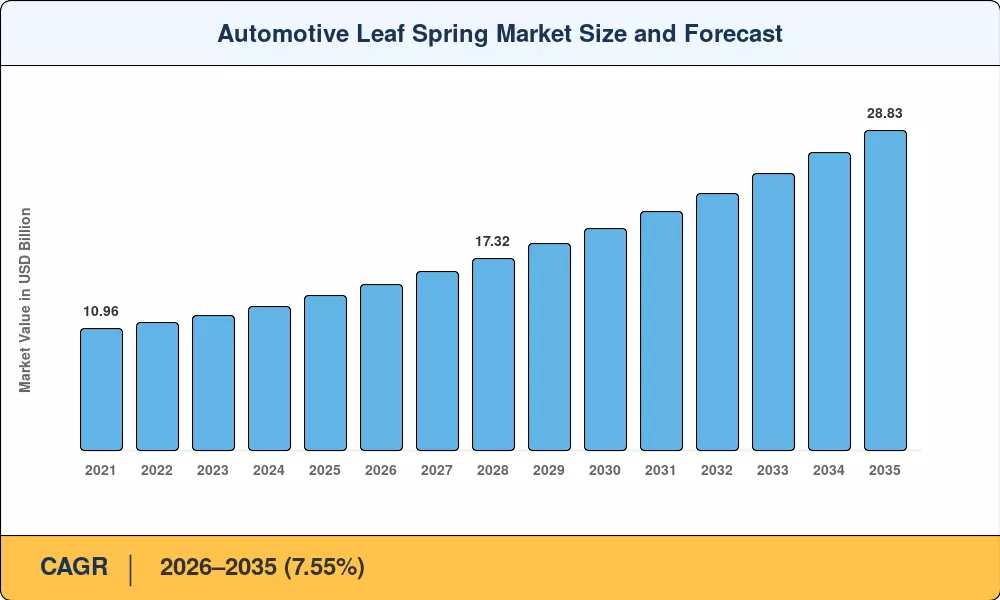
Automotive Leaf Spring Market Size Summary
Asia-Pacific accounted for 41.5% of global revenue in 2025 and is advancing at the fastest regional CAGR of 6.67%.
Semi-elliptical configurations accounted 59% of global Automotive Leaf Spring Market revenue in 2025, reflecting their entrenched position in heavy-duty truck platforms across Asia and North America.”
NY, CA, UNITED STATES, June 30, 2026 /EINPresswire.com/ -- As per Market Research Future, the Automotive Leaf Spring Market reached an estimated USD 13.92 billion in 2025, positioning itself for a forecast-period opening value of USD 14.97 billion in 2026 and a trajectory toward USD 28.83 billion by 2035 at a 7.55% CAGR. Two catalysts are fueling this acceleration: a global surge in commercial-vehicle production driven by e-commerce logistics infrastructure build-outs, and government mandates across the EU and China requiring fleet-level CO₂ intensity reductions that push OEMs toward lighter suspension assemblies. The International Energy Agency's Global EV Outlook 2025 projects that medium- and heavy-duty electric truck registrations will triple by 2030, creating fresh demand for spring systems engineered to offset battery mass without sacrificing payload ratings.— Arti Dhapte
A Transformation Underway in Suspension Technology
A transformation is unfolding inside the Automotive Leaf Spring Market trends as conventional multi-leaf steel packs give way to parabolic steel and fiber-reinforced composite designs. Composite springs can deliver weight savings of 50–70% per assembly compared to traditional steel, and OEMs such as Volvo Trucks and Daimler Trucks have committed over USD 400 million collectively to next-generation chassis lightweighting programs through 2028. Hybrid steel-composite architectures—pairing a single parabolic steel leaf with a glass-fiber overwrap—are emerging as a cost-effective bridge technology, especially for the aftermarket retrofit channel. This material evolution reflects the industry's broader push toward efficiency without compromising the structural integrity that leaf springs have provided for over a century.
Asia-Pacific dominates the Automotive Leaf Spring Market with roughly 41.5% of 2025 revenue, powered by India's and China's combined output of more than 12 million commercial vehicles annually. North America holds the second-largest position at approximately 22% share, buoyed by Class 8 truck replacement cycles and the reshoring of trailer manufacturing. Europe, contributing around 24% of global revenue, is the second-fastest-growing region as Euro VII emission standards compel fleet operators to adopt lighter suspension components. The decade ahead will reward suppliers who can scale composite production while maintaining the cost discipline that steel incumbents have perfected over generations.
📍 Get Free Sample Report for Detailed Market Insights:
https://www.marketresearchfuture.com/sample_request/8135
Key Drivers Accelerating Market Expansion
Commercial-Vehicle Production Growth
Global commercial-vehicle output surpassed 26-28% of total volume in 2024, and OICA projects a further 4–5% annual increase through 2028. Every light, medium, or heavy commercial vehicle rolling off an assembly line carries at least one leaf-spring assembly—and often two or more in tandem-axle configurations. India alone produced over 5.3 million CVs in FY 2024–25, a figure the Society of Indian Automobile Manufacturers expects to reach 6.8 million by FY 2029–30, anchoring the Automotive Leaf Spring Market's largest single-country volume pool. This production momentum is estimated to contribute approximately 22% of the market's CAGR impact.
EV Truck and Van Electrification
Suspension systems face unique challenges when used in battery-electric trucks. An electric Class 6 delivery truck can have 1,800-2,400 kg of battery mass that needs to be compensated for to meet payload ratings. The design conundrum favors modern parabolic steel and composite solutions, as OEMs are calling for springs with higher static load ratings while simultaneously asking to reduce mass from the spring itself. In March 2024, the U.S. EPA issued the Phase 3 GHG limits for medium and heavy-duty vehicles, creating a regulatory pull for zero-emission trucks that will reverberate through the Automotive Leaf Spring Market for a decade or more, contributing approximately 18% to the market's growth momentum.
Lightweighting Mandates
The EU's Euro VII regulation, scheduled for heavy-duty commercial trucks to enter mandatory enforcement from November 2028, sets stringent real-driving NOₓ and CO₂ limits that effectively require a 10–15% reduction in chassis kerb weight across heavy-duty platforms. Fleet operators in Europe are already placing specification contracts for parabolic spring packs that weigh 30% less than equivalent multi-leaf assemblies. China's Stage VI-b emission standard similarly incentivizes weight optimization, with regulatory compliance driving approximately 16% of the market's expansion.
E-Commerce Last-Mile Logistics Expansion
Light commercial vehicles—the backbone of urban delivery fleets—are the Automotive Leaf Spring Market's largest vehicle-type segment, and fleet churn rates in this category average just 4–5 years, ensuring a steady replacement cycle for spring assemblies. The exponential growth of e-commerce and the corresponding demand for last-mile delivery infrastructure have created sustained demand for LCV platforms, contributing approximately 14% to the market's growth trajectory.
Market Segmentation Insights
By Spring Type: Semi-Elliptical Dominates, Parabolic Shows Fastest Growth
Semi-elliptical configurations accounted for approximately 59% of global Automotive Leaf Spring Market revenue in 2025, reflecting their entrenched position in heavy-duty truck platforms across Asia and North America. Their simple architecture, ease of maintenance, and low unit cost keep them dominant in price-sensitive markets where cost efficiency often outweighs performance considerations.
Parabolic designs are projected to record the fastest segment CAGR of 7.58% through 2035, as fleet operators pursue ride comfort and weight-efficiency gains. Their tapered-thickness leaves reduce inter-leaf friction, delivering 15–30% weight savings and markedly smoother ride characteristics that increasingly appeal to fleet operators running long-haul routes where driver comfort affects retention and operational efficiency.
By Material: Steel Leads, Composite Accelerates
Steel held a commanding 69% share of the Automotive Leaf Spring Market in 2025, owing to lower upfront cost and established supply chains spanning raw material production through finished component manufacturing. The material's proven durability, established recycling infrastructure, and well-understood performance characteristics make it the default choice for most commercial vehicle applications.
Composite materials are on track for an 8.85% CAGR through 2035 as OEMs intensify lightweighting efforts. Glass-fiber-reinforced polymer mono-leaf springs have moved from niche European OEM applications into broader adoption, particularly on electric LCV platforms where every kilogram saved directly translates to extended range. The 50–70% weight savings over steel equivalents and demonstrated fatigue life exceeding 2 million cycles are driving adoption despite the current 25–40% price premium.
By Vehicle Type: Light Commercial Vehicles Lead
Light commercial vehicles led the Automotive Leaf Spring Market with approximately 39% revenue share in 2025, driven by last-mile delivery expansion. Every van and small truck platform—from the Ford Transit to the Tata Ace—relies on rear leaf springs as the primary load-bearing suspension element, creating a massive addressable market tied to e-commerce growth.
Medium and heavy commercial vehicles represent the largest absolute market at USD 5.12 billion in 2025, driven by freight logistics and infrastructure build-out. These vehicles typically require more robust spring assemblies with higher load ratings, creating higher value per unit compared to LCV applications.
By Sales Channel: OEM Dominates, Aftermarket Gains Momentum
OEM installations captured roughly 65% of total Automotive Leaf Spring Market revenues in 2025, reflecting the tight integration between suspension suppliers and vehicle manufacturers during platform development. OEM relationships are typically established years before production, creating stable revenue streams for qualified suppliers.
The aftermarket channel is accelerating at a 6.92% CAGR through 2035, driven by aging fleets and retrofit upgrades. Organized distributors expanding online ordering and next-day delivery are capturing share from informal workshops, particularly in emerging markets where fleet ages exceed 10–14 years.
🛒 You can buy this market report at:
https://www.marketresearchfuture.com/checkout?currency=one_user-USD&report_id=8135
Regional Analysis
Asia-Pacific: Largest Market and Fastest Growth
Asia-Pacific accounted for 41.5% of global revenue in 2025 and is advancing at the fastest regional CAGR of 6.67%. The region's leadership rests on China's production of over 6 million commercial vehicles annually and India's fast-growing output supported by the Production-Linked Incentive scheme, which earmarked INR 26,058 crore for the automotive components sector. Jamna Auto Industries, India's largest independent spring maker, expanded capacity by 20% in FY 2024–25 to meet surging domestic and export demand. China contributes 38% of regional revenue, while India's 8.9% CAGR represents the standout growth story.
Europe: Euro VII Compliance Driving Innovation
Europe contributes approximately 24% of global revenue, making it the second-fastest-growing region. Euro VII's real-driving emission requirements, effective from 2027, will compel European truck makers to cut chassis weight by an average of 350–500 kg across heavy-duty platforms. The Automotive Leaf Spring Market in Europe is consequently shifting toward parabolic and composite designs faster than any other region, with composite penetration expected to reach 12% of new-truck spring installations by 2030. Germany anchors regional demand with 26% of revenue, driven by Daimler and MAN OEM sourcing.
North America: Class 8 Truck Cycle and EV Launches
North America holds approximately 22% of global revenue, buoyed by Class 8 truck replacement cycles and EV truck launches. The U.S. dominates with 68% of regional revenue, driven by Class 8 truck production and EV mandates. ACT Research projects Class 8 production will reach 310,000 units in 2026. The Inflation Reduction Act's clean-vehicle tax credits have accelerated electric medium-duty van orders, and Freightliner's eCascadia program now specifies parabolic spring packs across all rear-axle configurations.
South America: Fleet Modernization Driving Growth
South America represents approximately 7% of global revenue, with Brazil accounting for 71% of regional demand. Brazil's ROTA 2030 automotive policy extends tax incentives for locally manufactured suspension components through 2028, positioning the country as the dominant node for the Automotive Leaf Spring Market across South America. Agribusiness freight and fleet modernization efforts drive sustained demand across the region.
Middle East & Africa: Infrastructure Build-Out
The Middle East & Africa region is expanding at a 5.55% CAGR through 2035, driven by infrastructure build-out and localized assembly. Saudi Arabia's Vision 2030 program is driving massive road-freight infrastructure investment, and the kingdom's national industrial strategy targets localized manufacturing of automotive suspension components. Africa's road-freight tonnage is projected to increase by 28% by 2030 as the African Continental Free Trade Area stimulates intra-regional trade.
Competitive Landscape and Key Players
The Automotive Leaf Spring Market exhibits medium concentration, with the top five players collectively holding an estimated 35–42% revenue share. The Herfindahl-Hirschman Index sits in the 800–1,200 range, consistent with a moderately fragmented structure where regional specialists coexist alongside global Tier-1 suppliers. Competition centers on material innovation, cost leadership, and proximity to OEM assembly plants.
NHK Spring Co., Ltd. (8–11% revenue share) leads as a technology leader with deep Japanese OEM relationships, offering multi-leaf and parabolic steel springs alongside composite prototypes. Rassini International (6–9% share) specializes in parabolic and tapered springs for heavy-duty trucks, serving North American and South American volume markets. Hendrickson International (5–8% share) provides suspension systems integrating leaf and air springs, positioning as a full-system integrator for the Class 8 segment. Jamna Auto Industries (5–7% share) is India's largest independent spring manufacturer, offering multi-leaf, parabolic, and lift-axle springs. Sogefi Group (3–5% share) provides steel and composite suspension components through a diversified automotive-component portfolio.
To explore more market insights, visit us at:
https://www.marketresearchfuture.com/reports/automotive-leaf-spring-market-8135
The Automotive Leaf Spring Market is positioned for sustained growth as commercial vehicle production expands, lightweighting mandates intensify, and material innovation transforms suspension technology. The market's projected expansion from USD 13.92 billion in 2025 to USD 28.83 billion by 2035, at a 7.55% CAGR, reflects the essential role of leaf springs in commercial vehicle platforms across the globe. Asia-Pacific's current dominance provides a foundation for global growth, while Europe's regulatory leadership and North America's Class 8 truck cycle demonstrate the market's diverse regional dynamics.
The migration from traditional multi-leaf steel packs toward parabolic steel and composite designs represents the most significant transformation in the market's history. Steel retains volume leadership, but composite materials are gaining share rapidly as weight savings of 50–70% become increasingly compelling for electric vehicle applications. Parabolic springs are the standout growth story within spring types, delivering ride comfort and weight-efficiency benefits that appeal to modern fleet operators. As the decade progresses, electrification, autonomous trucking, and circular-economy models will further reshape the Automotive Leaf Spring Market, creating opportunities for suppliers that can balance innovation with cost discipline. The market stands at the intersection of traditional suspension engineering and next-generation materials science, promising continued evolution through 2035 and beyond.
More Related Reports from Market Research Future Library:
https://www.marketresearchfuture.com/reports/zero-emission-vehicle-market-41192
https://www.marketresearchfuture.com/reports/small-off-road-engine-market-41207
https://www.marketresearchfuture.com/reports/solid-state-car-battery-market-41290
https://www.marketresearchfuture.com/reports/specialty-tire-market-41294
https://www.marketresearchfuture.com/reports/traction-control-system-market-41306
https://www.marketresearchfuture.com/reports/train-battery-market-41310
https://www.marketresearchfuture.com/reports/vehicle-exhaust-hose-market-41319
https://www.marketresearchfuture.com/reports/vehicle-rfid-tag-market-41323
https://www.marketresearchfuture.com/reports/vehicle-to-grid-technology-market-41325
https://www.marketresearchfuture.com/reports/automotive-magnesium-wheel-market-27791
https://www.marketresearchfuture.com/reports/automotive-adaptive-fog-lights-market-29529
Larry Wilson
WantStats Research And Media Pvt. Ltd.
+1 855-661-4441
email us here
Visit us on social media:
LinkedIn
Facebook
YouTube
X
Legal Disclaimer:
EIN Presswire provides this news content "as is" without warranty of any kind. We do not accept any responsibility or liability for the accuracy, content, images, videos, licenses, completeness, legality, or reliability of the information contained in this article. If you have any complaints or copyright issues related to this article, kindly contact the author above.
